

Schaumburg Honda Automobiles

Blog / Honda CR-V Hybrid for Sale in Schaumburg

Why the 2026 Honda CR-V Hybrid Outshines the 2026 Toyota RAV4 Hybrid

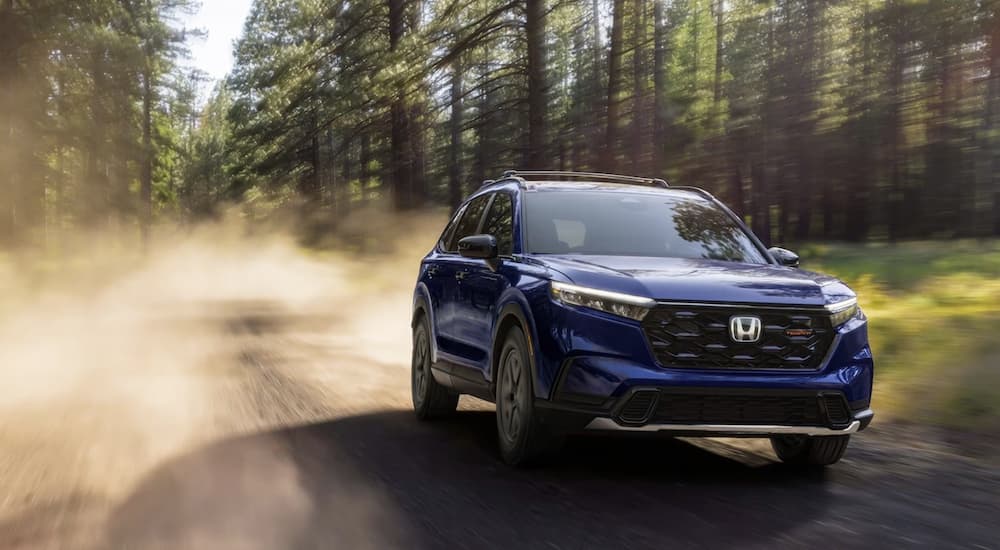
A blue 2026 Honda CR-V Hybrid off-roading on a dirt trail


Eco-conscious families, outdoor enthusiasts, and commuters have more choices than ever as car manufacturers continue to add to their hybrid and electric powertrain options, particularly in the compact SUV market. Two excellent options are the Honda CR-V Hybrid and the Toyota RAV4 Hybrid. Both brands are committed to delivering top-notch lineups, which might make you wonder who wins out when looking at the 2026 Honda CR-V Hybrid vs 2026 Toyota RAV4 Hybrid.

If you are looking for a Toyota RAV4 Hybrid or Honda CR-V Hybrid for sale in Schaumburg, both models promise fuel efficiency, versatile space, and strong reliability. However, a closer look reveals that the CR-V might check more of the boxes for today’s drivers. The good news is that our team here at Schaumburg Honda is well-versed in what the 2026 Honda CR-V Hybrid has to offer, ensuring you get the answers you need to make an informed choice.

You can view our selection online or stop by our dealership today. For now, keep reading to see how these two compact SUVs stack up when going head-to-head.

Fuel Efficient and Eco-Friendly Performance

One of the main reasons for choosing a hybrid over a traditional gasoline engine is improved fuel efficiency, and both of these compact SUVs deliver on this front. In fact, you will find that across the board, today’s hybrids are more dynamic than ever, dramatically reducing fuel consumption and emissions to help decrease your carbon footprint. This means that Schaumburg drivers have one less thing to think about as they head out for the day, making for a less stressful morning, not to mention reducing time and money spent at the gas station.

But efficiency is only part of the story. Comfort and refinement matter just as much for daily driving. With that being said, you will find that Honda’s engineers have fine-tuned the CR-V for a quiet, composed ride. Additionally, when accelerating, the CR-V’s hybrid powertrain presents minimal engine drone, while the RAV4’s engine might be a tad louder under pressure. While this might not seem like a significant issue, a quiet and pleasant ride into work allows you to focus on the day ahead.

Another thing to consider is that the CR-V’s chassis goes above and beyond what you might expect when it comes to handling. Its steering is well-weighted and precise, giving you confidence in corners and on winding roads. In everyday driving, this translates to the smooth, stable feel that today’s drivers want in their vehicle.

Infotainment display on a 2026 Honda CR-V Hybrid for sale in Schaumburg

Comfort and Connectivity

The 2026 CR-V Hybrid offers a spacious and thoughtfully laid-out interior that feels modern and fresh. This is thanks, in part, to its most recent redesign. The dashboard layout is also intuitive, with a clear touchscreen and physical knobs and buttons for the climate and audio controls. Additionally, even the base trim levels of the CR-V Hybrid come with a comprehensive list of standard features, including Apple CarPlay and Android Auto, which allow you to access your favorite playlists, navigation, and more.

Apple CarPlay and Android Auto aren’t the only technological perks. You will also find that all trims come with wireless charging, a Wi-Fi hotspot, and voice commands. Plus, Honda’s available 12-speaker Bose audio system provides concert-quality sound. While the RAV4 also offers many of these conveniences, you may need to pay more for them. For instance, remote engine start is standard on every CR-V Hybrid trim. All you need to do is hit a button on your key fob. For the RAV4, however, this helpful feature is only offered through Toyota Remote Connect and the Toyota App, which is subscription-based.

Rear-seat passengers especially enjoy the extra room in the CR-V, as tall adults fit more comfortably behind the driver than they do in the RAV4’s tighter backseat. Breaking down the numbers, the 2026 CR-V offers 41 inches of rear legroom, while the RAV4 provides backseat passengers with 37.8 inches of legroom. Additionally, the design of the CR-V maximizes visibility, offering a large rear window.

At the end of the day, both the CR-V and RAV4 have inviting interiors, but the CR-V may check more of the boxes on your wishlist, particularly when it comes to comfort and connectivity.

Versatility and Cargo Capacity

The CR-V Hybrid leads in practicality. Its rear seats fold in a 60/40 split, and the cargo floor is low to make loading easy. With the second row folded down, the CR-V provides 76.5 cu.ft. of storage, which is significantly more than the RAV4’s 70.4 cu.ft. That extra volume turns into real-world capacity, allowing you the freedom to accommodate both passengers and their belongings with ease.

For Schaumburg drivers who need more cargo space or a more specific cargo configuration, both the CR-V and RAV4 can be customized to meet your needs, thanks to the addition of roof rails, as well as optional amenities such as bike racks or luggage carriers. This adaptability helps the vehicle feel larger and ensures you continue to have the space you need inside, even when taking longer road trips.

Advanced Safety and Driver-Assist Systems

Safety is a priority for both brands, and that shines through in what the CR-V Hybrid and RAV4 Hybrid offer. For the 2026 CR-V, you will find that it is equipped with Honda Sensing, a suite of driver aids that includes automatic emergency braking, pedestrian detection, lane-departure mitigation, adaptive cruise control (with full stop-and-go), and more.

The 2026 RAV4 Hybrid offers Toyota Safety Sense, featuring similar technologies. One notable difference is Honda's Traffic Jam Assist: this system keeps the CR-V centered in its lane and accelerates and brakes as needed in stop-and-go traffic, while Toyota’s Lane Tracing Assist system only corrects drift at speeds over 30 mph. This difference might make a busy commute in the CR-V less tiring.
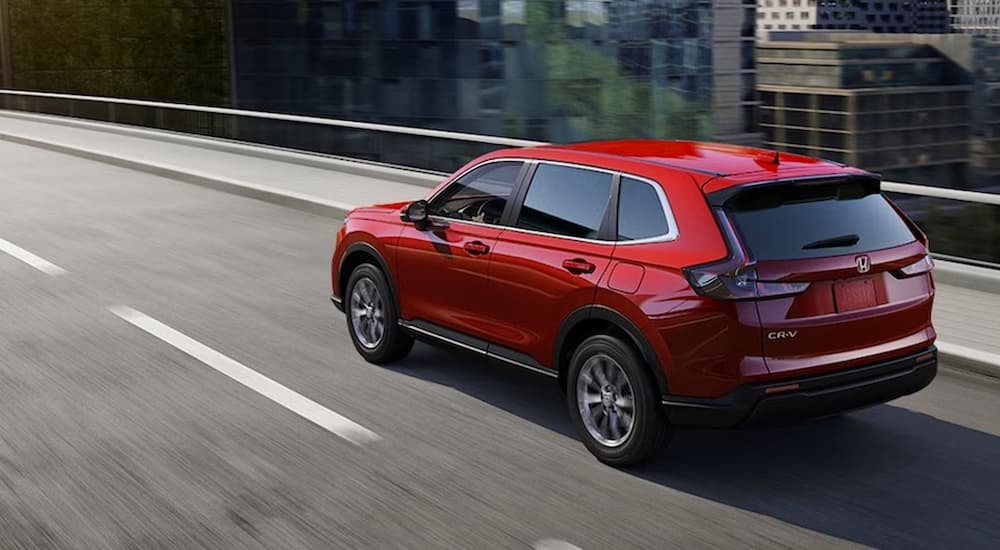
A red 2026 Honda CR-V Hybrid driving down a highway

Performance and Powertrain

Under the hood, the CR-V Hybrid’s 2.0L gasoline engine is paired with two electric motors, giving drivers a smooth and responsive feel. Additionally, electric torque from the motors ensures that the CR-V doesn’t feel underpowered off the line. It is worth noting that while the CR-V has slightly less horsepower on paper, these SUVs tied when testing how quickly they can reach 60 mph, coming in at 7.1 seconds each.

The CR-V came out on top overall, thanks to its quieter ride, particularly at highway speeds. This is thanks, in part, to its lack of a conventional transmission and greater reliance on its electric motors over its gasoline engine. What this means for you is that you can rest assured you have the passing power needed to get you where you are going, and you won’t need to battle engine noise when talking to your passengers.

Check Out the 2026 Honda CR-V Hybrid

The 2026 Honda CR-V Hybrid builds on what made the CR-V a fixture in the compact SUV segment while adding extra emphasis where it counts. It delivers a comfortable ride and a spacious, modern cabin packed with advanced technology and safety features. The CR-V Hybrid’s refined driving dynamics and numerous convenience features earn it high marks in terms of usability, while the brand’s exceptional durability helps ensure it will serve Schaumburg drivers well for the long haul.

If you are ready to take the next step, our team here at Schaumburg Honda invites you to reach out to us online or stop by our dealership for a test drive. Either way, we are happy to answer any questions you might have to ensure you get the right match for your driving routine.
Posted in:

Related Posts

A white 2025 Honda CR-V Hybrid driving down a highway

How Does the Dual-Motor Hybrid System in the CR-V Hybrid Work?

The Honda CR-V is indisputably one of North America’s most popular vehicles. In fact, according to Edmunds, it was the best-selling new vehicle nameplate in Illinois for 2024, and held the same title in four other states. A big reason for this is the hybrid variant, which boosts power and fuel efficiency while maintaining the roomy passenger and cargo areas that people love. If you have driven the CR-V Hybrid, you may have noticed it behaves quite differently from traditional gasoline cars. Much of this is due to the unique Honda dual-motor hybrid system and the way it simplifies performance. Before deciding whether to find a Honda CR-V Hybrid for sale in Schaumburg, it’s useful to understand the fundamentals of its powertrain and the advantages it provides. In this guide, we’ll look at how the Honda dual-motor hybrid system operates, how it compares to other common hybrid systems, and why the CR-V setup might be the better pick. more Tracing the History of the Honda Dual-Motor Hybrid System Before anything else, though, we want to give Schaumburg drivers a quick background on the dual-motor system and how it came to be. Honda developed its original two-motor hybrid system in response to increasing customer and government demands for better fuel economy and lower vehicle emissions. At the same time, the manufacturer didn’t want such a system to negatively affect performance, comfort, or aesthetics. The two-motor system, also known as the Original Honda Hybrid System or e:HEV, debuted in the 2014 Honda Accord Hybrid. When Honda refreshed the fifth-generation CR-V in 2020, it included a hybrid model for the first time, which used this dual-motor setup. Honda has continued to improve the technology, making it more powerful, capable, and smaller. Since 2023, the CR-V and Accord have utilized the fourth generation of the two-motor hybrid powertrain. Demystifying the Mechanics of the CR-V Hybrid Now let’s get into how the dual-motor hybrid system works and what it offers. The e:HEV setup involves six primary components that work together. Here’s an outline of each: The electric generator motor connected to the engine provides power to a lithium-ion hybrid battery and the propulsion motor. The electric propulsion motor, or traction motor, sends power directly to the wheels. A 2.0L Atkinson-cycle gas engine can power the generator motor or connect to the front wheels directly. It is designed for a thermal efficiency of around 40% instead of the normal 25% to 30%. The lock-up clutch transmission will automatically shift the system from the electric motor to the gasoline engine and back again. The Intelligent Power Unit (IPU) contains a hybrid battery along with a computer to store electricity and control its distribution. The Power Control Unit (PCU) inside the engine compartment controls the overall system and manages the power flow between the engine, motors, and battery. All this results in an intelligent series-parallel hybrid system that effortlessly switches between different modes: When the CR-V Hybrid is accelerating from a stop or driving around Schaumburg, it runs like a battery-electric vehicle in EV Drive Mode, using only the propulsion motor powered by the battery. In Hybrid Drive Mode, the vehicle is powered by the motor, but the engine is also running to generate electricity, which charges the battery and enables powerful acceleration. At highway cruising speeds, engine propulsion becomes more efficient, and the Honda CR-V will switch you to Engine Drive Mode, directly connecting the engine to the front axle. When you hit the brakes, whether at a traffic light or while going down a hill, it activates Regenerative Braking Mode to recharge the battery. Also worth noting is that with the fourth-generation hybrid system, the Honda CR-V Hybrid changed the electric motors from an in-line to a parallel configuration and added high-performance magnets to the propulsion motor. This allowed Honda to make the motors more powerful for increased torque that is more linear, and it raised the peak motor RPM for higher top-end speed. Honda also added another direct-drive gear set, which enabled towing capability for the first time and allows Engine Drive Mode to be used at lower speeds if the battery runs dry. Finally, this setup allowed the CR-V Hybrid to be driven in front-wheel drive or real-time all-wheel drive. Honda Dual-Motor Hybrids vs Other Hybrids You may have guessed that Honda’s hybrid system is unusual—and you’d be correct. Most automotive manufacturers build parallel-only hybrids, where the engine is always the primary driver with the electric motor(s) assisting as needed. They also mate them to traditional powertrain components, such as multi-speed automatic transmissions, torque converters, and power splitters. Even other automakers that have gone the series-parallel hybrid route, such as Toyota, are still stuck on classic transmissions. A few automakers go the other way with a series-only hybrid setup, where the motor(s) are always driving the vehicle and the engine acts solely as a power generator. However, these systems demand larger batteries and more powerful motors to provide useful performance at higher speeds, pushing up the cost and complexity of the vehicle, and are typically only found in plug-in hybrids. The Benefits of a Honda CR-V Dual-Motor Hybrid If all else is equal, why should you get a Honda CR-V Hybrid instead of another type of hybrid? Here are the biggest advantages Schaumburg drivers will find behind the wheel of a dual-motor CR-V Hybrid: By switching between series, parallel, and series-parallel operation, Honda’s hybrid system always works in the most efficient way, meaning better gas mileage and range, lower emissions, and less wasted power. The Honda e:HEV power distribution mechanism is far less complex than the common parallel hybrids. Not only does this further improve efficiency and make the CR-V Hybrid drive more smoothly, but it also means fewer failure points and less maintenance, lowering overall costs with higher reliability. The intelligent system can combine the gas engine and electric motors when needed or on demand to greatly increase maximum power output. You’ll be able to accelerate more quickly and go faster, whether for practical reasons or because you want an adrenaline jolt. Thanks to four generations of refinement and fewer moving parts, Honda’s e:HEV takes up less space than other hybrid systems. This means that, unlike other hybrid models that have much less passenger and cargo room than the gas-only versions, there is no difference in the CR-V Hybrid. Also, since the equipment is lighter, it doesn’t negate the other performance and efficiency upsides. Pair Efficiency With Performance in the Honda CR-V Hybrid Thanks to Honda’s in-house, one-of-a-kind design, the Honda CR-V Hybrid represents a fresh take on hybrid technology in a small SUV. The optimal power delivery, peak fuel efficiency, dependable operation, and negligible equipment footprint are an incredible combination. When you consider the other great things about the Honda CR-V Hybrid, like the spacious cabin and extensive safety technology, it’s no wonder drivers in Schaumburg and all of Illinois flock to this vehicle. Try the Honda CR-V Hybrid for yourself here at Schaumburg Honda and discover how its powertrain is more than talk. Since 1985, we have been dedicated to treating local drivers like family and giving them the world-class service they deserve. A knowledgeable sales team member will be happy to tell you more about the CR-V Hybrid and help you find a new or used model that fits your needs. We are here to create a partnership for life, from no-hassle financing to vehicle maintenance from Honda-certified technicians. The Honda CR-V was the top-selling car in Illinois, Ohio, New York, Pennsylvania, and Virginia in 2024, according to Edmunds. For more information, visit Edmunds at www.edmunds.com. Edmunds is a part of CarMax, Inc.