

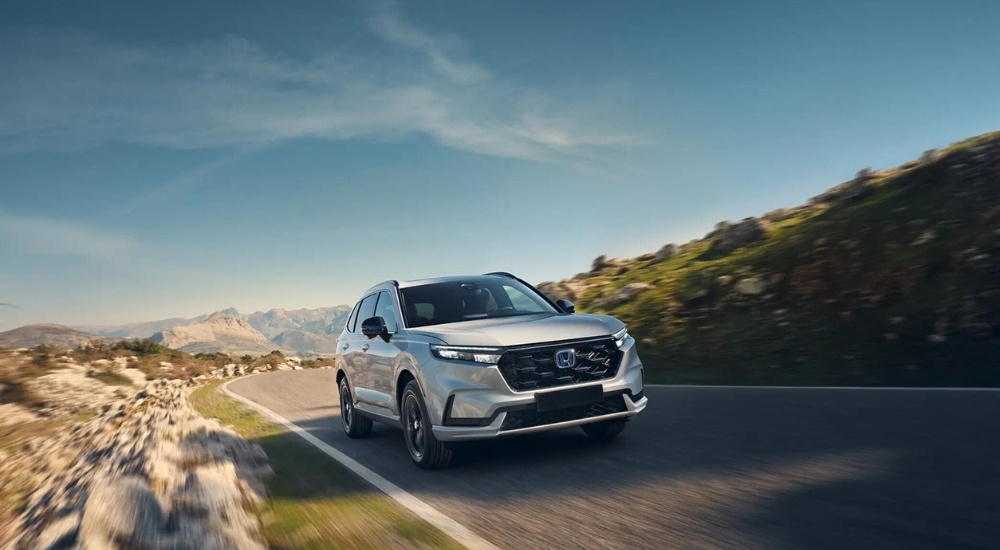
The Honda CR-V is indisputably one of North America’s most popular vehicles. In fact, according to Edmunds, it was the best-selling new vehicle nameplate in Illinois for 2024, and held the same title in four other states.[a] A big reason for this is the hybrid variant, which boosts power and fuel efficiency while maintaining the roomy passenger and cargo areas that people love.
If you have driven the CR-V Hybrid, you may have noticed it behaves quite differently from traditional gasoline cars. Much of this is due to the unique Honda dual-motor hybrid system and the way it simplifies performance. Before deciding whether to find a Honda CR-V Hybrid for sale in Schaumburg, it’s useful to understand the fundamentals of its powertrain and the advantages it provides.
In this guide, we’ll look at how the Honda dual-motor hybrid system operates, how it compares to other common hybrid systems, and why the CR-V setup might be the better pick.
Tracing the History of the Honda Dual-Motor Hybrid System
Before anything else, though, we want to give Schaumburg drivers a quick background on the dual-motor system and how it came to be. Honda developed its original two-motor hybrid system in response to increasing customer and government demands for better fuel economy and lower vehicle emissions. At the same time, the manufacturer didn’t want such a system to negatively affect performance, comfort, or aesthetics.
The two-motor system, also known as the Original Honda Hybrid System or e:HEV, debuted in the 2014 Honda Accord Hybrid. When Honda refreshed the fifth-generation CR-V in 2020, it included a hybrid model for the first time, which used this dual-motor setup. Honda has continued to improve the technology, making it more powerful, capable, and smaller. Since 2023, the CR-V and Accord have utilized the fourth generation of the two-motor hybrid powertrain.
Demystifying the Mechanics of the CR-V Hybrid
Now let’s get into how the dual-motor hybrid system works and what it offers. The e:HEV setup involves six primary components that work together. Here’s an outline of each:
- The electric generator motor connected to the engine provides power to a lithium-ion hybrid battery and the propulsion motor.
- The electric propulsion motor, or traction motor, sends power directly to the wheels.
- A 2.0L Atkinson-cycle gas engine can power the generator motor or connect to the front wheels directly. It is designed for a thermal efficiency of around 40% instead of the normal 25% to 30%.
- The lock-up clutch transmission will automatically shift the system from the electric motor to the gasoline engine and back again.
- The Intelligent Power Unit (IPU) contains a hybrid battery along with a computer to store electricity and control its distribution.
- The Power Control Unit (PCU) inside the engine compartment controls the overall system and manages the power flow between the engine, motors, and battery.
All this results in an intelligent series-parallel hybrid system that effortlessly switches between different modes:
- When the CR-V Hybrid is accelerating from a stop or driving around Schaumburg, it runs like a battery-electric vehicle in EV Drive Mode, using only the propulsion motor powered by the battery.
- In Hybrid Drive Mode, the vehicle is powered by the motor, but the engine is also running to generate electricity, which charges the battery and enables powerful acceleration.
- At highway cruising speeds, engine propulsion becomes more efficient, and the Honda CR-V will switch you to Engine Drive Mode, directly connecting the engine to the front axle.
- When you hit the brakes, whether at a traffic light or while going down a hill, it activates Regenerative Braking Mode to recharge the battery.
Also worth noting is that with the fourth-generation hybrid system, the Honda CR-V Hybrid changed the electric motors from an in-line to a parallel configuration and added high-performance magnets to the propulsion motor. This allowed Honda to make the motors more powerful for increased torque that is more linear, and it raised the peak motor RPM for higher top-end speed.
Honda also added another direct-drive gear set, which enabled towing capability for the first time and allows Engine Drive Mode to be used at lower speeds if the battery runs dry. Finally, this setup allowed the CR-V Hybrid to be driven in front-wheel drive or real-time all-wheel drive.
Honda Dual-Motor Hybrids vs Other Hybrids
You may have guessed that Honda’s hybrid system is unusual—and you’d be correct. Most automotive manufacturers build parallel-only hybrids, where the engine is always the primary driver with the electric motor(s) assisting as needed. They also mate them to traditional powertrain components, such as multi-speed automatic transmissions, torque converters, and power splitters. Even other automakers that have gone the series-parallel hybrid route, such as Toyota, are still stuck on classic transmissions.
A few automakers go the other way with a series-only hybrid setup, where the motor(s) are always driving the vehicle and the engine acts solely as a power generator. However, these systems demand larger batteries and more powerful motors to provide useful performance at higher speeds, pushing up the cost and complexity of the vehicle, and are typically only found in plug-in hybrids.
The Benefits of a Honda CR-V Dual-Motor Hybrid
If all else is equal, why should you get a Honda CR-V Hybrid instead of another type of hybrid? Here are the biggest advantages Schaumburg drivers will find behind the wheel of a dual-motor CR-V Hybrid:
- By switching between series, parallel, and series-parallel operation, Honda’s hybrid system always works in the most efficient way, meaning better gas mileage and range, lower emissions, and less wasted power.
- The Honda e:HEV power distribution mechanism is far less complex than the common parallel hybrids. Not only does this further improve efficiency and make the CR-V Hybrid drive more smoothly, but it also means fewer failure points and less maintenance, lowering overall costs with higher reliability.
- The intelligent system can combine the gas engine and electric motors when needed or on demand to greatly increase maximum power output. You’ll be able to accelerate more quickly and go faster, whether for practical reasons or because you want an adrenaline jolt.
- Thanks to four generations of refinement and fewer moving parts, Honda’s e:HEV takes up less space than other hybrid systems. This means that, unlike other hybrid models that have much less passenger and cargo room than the gas-only versions, there is no difference in the CR-V Hybrid. Also, since the equipment is lighter, it doesn’t negate the other performance and efficiency upsides.
Pair Efficiency With Performance in the Honda CR-V Hybrid
Thanks to Honda’s in-house, one-of-a-kind design, the Honda CR-V Hybrid represents a fresh take on hybrid technology in a small SUV. The optimal power delivery, peak fuel efficiency, dependable operation, and negligible equipment footprint are an incredible combination. When you consider the other great things about the Honda CR-V Hybrid, like the spacious cabin and extensive safety technology, it’s no wonder drivers in Schaumburg and all of Illinois flock to this vehicle.
Try the Honda CR-V Hybrid for yourself here at Schaumburg Honda and discover how its powertrain is more than talk. Since 1985, we have been dedicated to treating local drivers like family and giving them the world-class service they deserve. A knowledgeable sales team member will be happy to tell you more about the CR-V Hybrid and help you find a new or used model that fits your needs. We are here to create a partnership for life, from no-hassle financing to vehicle maintenance from Honda-certified technicians.
[a]The Honda CR-V was the top-selling car in Illinois, Ohio, New York, Pennsylvania, and Virginia in 2024, according to Edmunds. For more information, visit Edmunds at www.edmunds.com. Edmunds is a part of CarMax, Inc.
Connect with us


- February 2026
- November 2025
- October 2025
- September 2025
- August 2025
- July 2025
- May 2025
- April 2025
- March 2025
- February 2025
- June 2024
- May 2024
- April 2024
- March 2024
- February 2024
- January 2024
- December 2023
- November 2023
- October 2023
- September 2023
- August 2023
- July 2023
- June 2023
- May 2023
- March 2023
- January 2023
- December 2022
- October 2022
- September 2022
- July 2022
- June 2022
Archives
- Honda Alignment Checks
- Honda CR-V for Sale
- Honda CR-V Hybrid for Sale
- Honda CR-V Hybrid for Sale in Schaumburg
- Honda Dealer
- Honda Dealer Near Bloomingdale
- Honda Dealer Near Buffalo Grove
- Honda Dealer Near Morton Grove
- Honda Dealer Near Naperville
- Honda Dealer Near Wheaton
- Honda DNealer ear Lisle
- Uncategorized